If you’re a Spanish teacher, you’ve probably experienced this situation before.
It’s Sunday afternoon. You sit down with your laptop, a cup of coffee, and every intention of planning quickly for the week ahead. Then one hour turns into three. You’re searching for activities, looking for vocabulary practice, finding a reading, creating a worksheet, trying to locate a speaking task, and somehow connecting everything into a lesson sequence that makes sense.
By the time you’re done, you’ve spent most of your weekend preparing for just one week of instruction.
We now have available a Free Full Week of Lesson Plans for Spanish 1 to give you a complete, organized week of Spanish classes that is ready to use, modify, or adapt.
Instead of receiving a random worksheet or isolated activity, you’ll get a complete instructional sequence showing how our Spanish Teachers Community lesson plans come together with every piece of activity and assessment already mapped out.
Whether you’re a first-year Spanish teacher, a teacher returning after a long break, or a veteran educator looking to save time, this free week was designed to make your life easier.

Free Lesson Plans for Spanish 1 with Pacing Guide: Así soy
 The internet is full of free Spanish activities. The problem is that most of them are disconnected.
You might find a vocabulary worksheet on one website, a speaking activity on another, and a reading somewhere else. Then you become responsible for figuring out how those pieces fit together into meaningful instruction.
This free Spanish 1 week takes a completely different approach.
Instead of giving you individual activities, the Pacing Guide included shows how lessons can build naturally from one day to the next. Every lesson connects to the previous lesson and prepares students for what comes next.
The result is a smoother classroom experience for both teachers and students.
🧠 Students aren’t constantly switching topics.
⏰ Teachers aren’t constantly searching for what to do next.
Everyone can focus on learning.
The Spanish 1 full week is organized around the theme “Así Soy Yo” (This Is Who I Am).
This theme is especially effective for beginning language learners because it focuses on topics students genuinely enjoy talking about: themselves, their interests, their friends, and their families.
Rather than memorizing vocabulary in isolation, students immediately begin using Spanish to communicate personal information.
Throughout the week, learners practice introducing themselves, describing who they are, talking about what they like, discussing family members, and describing physical and personality traits.
These are exactly the kinds of real-world communication skills beginners need.
Day 1: Greetings and Introductions
The first lesson focuses on greetings, introductions, and the informal pronouns “yo” and “tú.” For many Spanish 1 students, this is their first opportunity to use Spanish for authentic communication.
The lesson includes activities that encourage students to introduce themselves, greet classmates, and participate in listening and speaking exercises. Instead of simply memorizing vocabulary lists, students actively use language in meaningful contexts.
The lesson also includes a reading about greetings and introductions that helps reinforce key vocabulary and structures.
By the end of the day, students aren’t just learning words. They’re starting to communicate.
Lesson Plans and Support Materials for Day 1
 1. Greetings and Introductions – Subject Pronouns YO and TU Lesson Plan – Through reviewing three videos and a presentation, the students will learn how to exchange personal information (name, origin, age), some basic greetings, and the subject pronouns yo and tú. They will practice these learnings through written practice, a card game, and by creating an original dialogue using the appropriate expressions to greet and introduce themselves in Spanish.
 2. Greetings and Introductions Reading – Students will practice Spanish greetings, introductions, personal information, and expressions of farewell through three conversations. They will strengthen their reading comprehension by answering questions about greetings, names, origins, and appropriate expressions for different times of the day.
Day 2: Subject Pronouns
Subject pronouns can easily become one of the most boring grammar lessons in Spanish 1. But they don’t have to be.
In this lesson, students explore personal pronouns through presentations, deduction activities, memory games, and group practice.
Instead of being told grammatical rules and expected to memorize them, learners actively discover patterns and then apply what they’ve learned.
The lesson also includes printable subject pronoun posters that can continue supporting students long after the lesson ends. This combination of visual supports, interactive activities, and practice opportunities helps make grammar feel more approachable for novice learners.
Lesson Plans and Support Materials for Day 2
 1. Subject Pronouns, Personal Pronouns Game and Lesson Plan – Through an illustrated presentation, the students will learn the subject pronouns. Then, they will play two games to review and remember them. Finally, they will practice them orally by creating a series of sentences. Includes a printable and Flippity memory game.
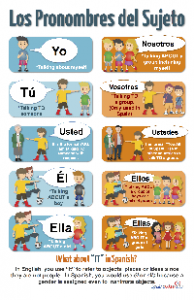 2. Subject Pronouns (Singular + Plural) Printable Posters – Students will learn and review Spanish subject pronouns with illustrated posters. They’ll practice singular and plural forms, formal and informal pronouns, and how Spanish assigns gender to objects.
Day 3: Likes, Dislikes, Sports, and Hobbies
One of the easiest ways to increase engagement in Spanish class is to talk about topics students already care about.
⚽ Sports.
🎵 Music.
🎨 Hobbies.
🎯 Favorite activities.
The third day introduces students to expressing likes and dislikes while learning vocabulary connected to sports and hobbies.
Through videos, surveys, vocabulary practice, and classroom interaction, students learn how to communicate opinions using structures such as “me gusta” and “no me gusta.”
Students aren’t just completing grammar exercises.They’re discussing things they genuinely enjoy. That is the type of communication students remember.
The lesson also includes a bonus sub-plan called “My Music Journal,” which can provide additional reinforcement and flexibility for teachers.
Lesson Plans and Support Materials for Day 3
 1. Likes and Dislikes – Sports and Hobbies Lesson Plan – At the end of the activity, students will have reviewed and used orally and in writing, the vocabulary about sports and hobbies, likes, and dislikes according to the different degrees. Through videos and visual materials, students will review their knowledge of sports, hobbies, likes, and dislikes vocabulary and expressions.
 2. My Music Journal Substitute Lesson Plan for Novice Students – Students will listen to audio‑only samples of 10 Latin music genres (e.g., merengue, salsa, vallenato, flamenco). For each genre, they will create two Google Slides: Genre information (country, instruments, cultural fact, picture) + Song sample and Spanish opinion using me gusta / no me gusta / me encanta.
Day 4: Family Vocabulary
Family vocabulary is a staple of Spanish 1 courses. However, students often struggle to connect long vocabulary lists to actual communication.
This lesson takes a more meaningful approach.
Students learn how to describe family members, relationships, ages, and physical characteristics while working through activities that help make the vocabulary memorable. The lesson incorporates movement activities, videos, songs, and family-themed resources that help bring the vocabulary to life.
Students receive additional support through a family vocabulary list and identification sheet that can be used for practice and review. By focusing on students’ own families, the lesson becomes personal and engaging.
Lesson Plans and Support Materials for Day 4
 1. Family and Relatives Vocabulary – Physical Traits, Relationships, Age and Names Lesson Plan – By the end of this activity, students will have learned the family vocabulary, how to describe people, and to ask and answer names and ages. Students will have practiced the vocabulary orally and written in context. They will be able to understand and produce the concepts.
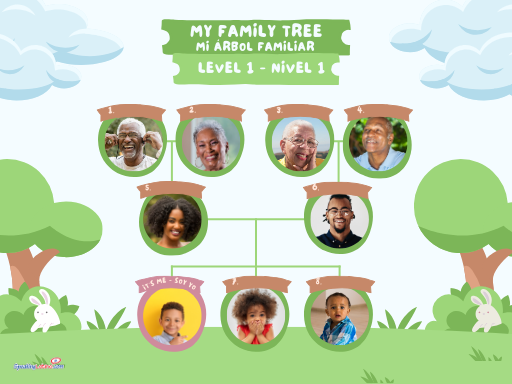 2. La familia – Vocabulary Lists and ID Sheets – Students will learn basic family vocabulary with an English-Spanish word list and an illustrated family tree. They’ll identify and label family members in Spanish, from grandparents and parents to brothers and sisters.
Day 5: Personality Traits and SER vs. ESTAR
Few grammar topics create more anxiety for beginning Spanish students than SER and ESTAR. Teachers know the challenge.
Students often ask: “Why are there two verbs that both mean ‘to be’?”
This lesson introduces personality traits, adjective agreement, and SER vs. ESTAR in a way that feels practical and connected to communication. Students describe people, analyze examples, complete guided practice, and participate in activities that help clarify when each verb should be used.
A supplemental SER vs. ESTAR reading provides additional reinforcement for students who need extra practice.
Rather than treating grammar as an isolated topic, students learn it as part of describing themselves and others.
Lesson Plans and Support Materials for Day 5
 1. Adjective Agreement, SER vs ESTAR – Physical and Personality Traits Lesson Plan – Through reviewing educational videos on a website, students review the uses of ser & estar and their conjugations in the present tense. They learn common vocabulary words that describe physical and personality traits and review adjective agreement rules. They apply all these learnings through a guided class exercise and a fashion critique oral presentation.
 2. Ser vs Estar Reading – Students will review the uses of ser and estar through an explanatory reading and the DOCTOR and PLACE acronyms. They will practice choosing the correct verb forms in context and strengthen their reading comprehension by answering questions about a Spanish class.
Day 6: Optional Assessment
Assessment is another area that often creates additional planning hours for teachers.
Many educators build strong lessons but then have to create quizzes, writing prompts, listening activities, speaking assessments, and reading comprehension tasks from scratch.
This free week of lesson plans includes an optional end-of-week assessment that incorporates listening, writing, speaking, and reading skills.
Students have the opportunity to demonstrate growth across multiple communication modes rather than relying on one traditional test and creates a more complete picture of student learning.
More Than Just Free Lesson Plans
One of the biggest misconceptions teachers have when they hear “free lesson plans” is assuming they’re getting a few pages of instructions. That’s not what’s happening here.
This sample week includes far more than daily plans.
Teachers also receive the supplemental resources mentioned above such as readings, posters, vocabulary activities, identification sheets, assessments, and additional practice materials.
Everything has already been selected and sequenced.
There is no guessing. There is no hunting for materials.
When instruction is disconnected, students notice.
One day feels unrelated to the next.
Vocabulary appears randomly.
Grammar feels isolated.
Lessons seem disconnected.
A structured week changes everything.
Because this full week of lesson plans follows a logical progression, students continuously build on previous knowledge.
What they learn on Monday supports what they do Tuesday… Tuesday supports Wednesday… And by Friday, students can draw upon everything they have learned throughout the week.
This sequence creates confidence.
Flexible for Different Classrooms
The lessons can be used exactly as written, modified slightly, or adapted significantly depending on your students’ needs.
Maybe you teach 8th grade.
Maybe you teach high school.
Maybe you need to slow down.
Maybe you want to move faster.
The pacing guide provides structure while still allowing you to teach in a way that works for your students.
The pacing guide also contains instructions and links that allow teachers to make copies of the lesson materials directly into Google Drive. A Google account is recommended because it makes organizing and copying the resources much easier.
Teachers who prefer not to use Google Drive can also access resources through the Freebies Area.
Ready to Take a Week of Planning Off Your Plate?
Teaching Spanish should be rewarding. ❤️
It shouldn’t require sacrificing your evenings and weekends every single week.
That’s why we are giving away this week of Spanish 1 lessons.
You’ll receive a complete week of instruction covering greetings, introductions, subject pronouns, likes and dislikes, family vocabulary, personality traits, and SER vs. ESTAR, along with assessments and supplemental resources.
Download the free sample week today and discover how much easier lesson planning can be when everything is already mapped out and ready to teach.

You must be logged in to post a comment.