
In Spanish, a lot of words may be altered slightly with diminutives or colloquialisms and still mean more or less the same thing, for example with “galleta” (cookie/cracker) and “galletita” (little cookie/cracker”). Chileans, in particular, are famous for their -itos. It is then understandable that one might confuse the words “caballo” and “caballero” and assume […]
The Argentina Spanish Street Slang Phrase MANDAR FRUTA
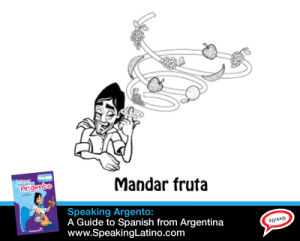
Sometimes, even native Spanish speakers can get tripped up by words and phrases used in other countries. A good friend of mine, Jorge is from Colombia but moved to Argentina to go to school. His Spanish and English are both impeccable, so I take great joy in any of his minor slip ups. It just […]
The Harshest Argentina Spanish Street Slang Insult: AALRPMQTRP

AALRPMQTRP Try saying that three times fast. I bet you didn’t learn the pronunciation rules for that many consonants in a row! Okay, okay, I’ll come clean. This is not a Spanish word, it is actually an acronym for the worst Argentine insult you can dish out: Andáte a la re puta madre que te re […]
Argentina Spanish Lesson: How to Conjugate the Vos Form

If you have never been to Argentina, chances are you have never even heard of the vos form. It is not to be confused with the vosotros form, which is native to Spain and also frequently ignored in the classroom. The vos form is native to Argentina and is interchangeable with tú. While Argentinians will understand […]
Learning Argentina Spanish: ¿ME TENÉS?

The first time my Argentine friend asked me ¿me tenés? I was a little confused. By that time, I was at least used to the vos form conjugation of “tener,” but the direct translation “You have me?” left me drawing a blank. Luckily, I was able to figure this out through context because she was shoving […]
Learning Spanish Slang: 4 Ways to Say FRIENDS WITH BENEFITS

Sex, love and everything in between can be tricky to describe in any language and Spanish is no exception. Each country seems to have its own slang for that gray area that in English is referred to as “friends with benefits” or, if you are feeling crass, fuck-buddies. Here are a few Spanish synonyms from […]
CAGAR vs CARGAR: An Embarrassing Spanish Speaking Lesson

When you are learning a language, it is easy to brush off certain things as unimportant. You simply want to get your point across, so you can’t waste time trying to perfect every aspect of your speech when you need to communicate. Usually, this is fine and with enough context, you will be understood, more […]
A Slice of the Spanish Pie: 8 Spanish Language Words for SLICE
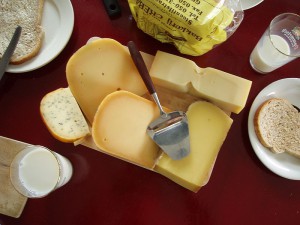
You would think a word as simple as slice would have only one translation. Unfortunately, that is not the case. The noun SLICE in Spanish has seemingly countless translations, each one is specific to whatever you are slicing. Here are a few of the more common translations: 1. Trozo Used for slices of cake or […]
SUBÍS: Learning Argentina Spanish for Going Up and Getting On

Just like in any language, Spanish has many words that have multiple meanings. The word “SUBIR” has several different meanings such as to go up, to get on, to climb up, to raise and many others along the same lines. Usually, you can figure it out from context, but the other day I came across […]
A Funny Story About the Spanish Language Word BOMBA

Now, if you are looking at the word BOMBA in Spanish for the first time or even as someone who has studied Spanish for years, you are probably thinking it means “bomb”. Well, that is correct. Most of the time. I studied Spanish for several years before I headed to Mexico. I was pretty confident […]
Learning Spanish Lessons: The Distinction Between PARECER and PARECERSE

Parecer and parecerse a both mean “to resemble” or “to look like” but they cannot be used interchangeably. Parecer is used to describe the appearance of something, such as “He looks like a teacher” while parecerse is used to compare between items, such as “He looks like my teacher Mr. Sanchez.” or to give an […]
Learn Spanish: Translating BUT to Spanish with PERO and SINO / SINO QUE

The words pero and sino both translate to “but.” However, they cannot be used interchangeably. Pero is used when you are looking to convey “nevertheless” or “yet.” Examples: Estaba muy cansada, pero no me dormí. (I didn’t fall asleep, but I was very tired.) No tenemos gaseosa, pero tenemos limonada. (We don’t have soda, but […]
English to Spanish Translations: 3 Ways TO MOVE in Spanish

This post is part of the series Warming up for El Día E: Posts to Improve Your Spanish. El Día E is a world-wide celebration of the Spanish Language that will take place on June 23th, 2012. Posts in this series to celebrate El Día E: 1. Join the Celebration of El Día E 2. […]
Learn Spanish Words for TO KNOW: SABER versus CONOCER

This post is part of the series Warming up for El Día E: Posts to Improve Your Spanish. El Día E is a world-wide celebration of the Spanish Language that will take place on June 23th, 2012. Posts in this series to celebrate El Día E: 1. Join the Celebration of El Día E 2. […]
Learning Spanish Lessons: The Difference Between PEDIR and PREGUNTAR

This post is part of the series Warming up for El Día E: Posts to Improve Your Spanish. El Día E is a world-wide celebration of the Spanish Language that will take place on June 23th, 2012. Posts in this series to celebrate El Día E: 1. Join the Celebration of El Día E 2. […]
Learn Spanish: 4 Meanings of RIGHT in Spanish

There are several words/phrases that translate to RIGHT in Spanish: derecho, derecha, correcto, and tener razón. Of course, not all of them can be used interchangeably – that would just be too easy. Here are the Spanish word for RIGHT most common options right. 1. Right in Spanish: DERECHO El derecho, used as a noun, […]
How to Order Ice Cream in Spanish

Anyone who knows me is aware of my extreme obsession with ice cream. When I travel, the ability to find and order ice cream is fundamental. There are a lot more words associated with ice cream than I originally thought, so I wanted to share the knowledge I have gained with all of you. Ice […]
The Worst English to Spanish Translation for HOT

In English, the word “hot” can refer to temperature, spiciness or to attractiveness. The word for “hot” in Spanish, in reference to temperature is caliente, which also has more than one meaning. Just not the same meanings as in English. So, check out this story that teaches you which is the most embarrassing English to […]
Learn Spanish: Using Augmentatives in Spanish

Just like diminutives, augmentatives have different uses and there are several augmentative endings. These often convert everyday words into local slang. The most common Spanish Suffixes are: ón/ona, ozo/oza, and ote/ota. In Spanish, augmentatives are used to express large size or great intensity Examples: Grande – big Grandote – huge Perro – dog Perrote – […]
Spelling Spanish Words: Language Mistakes That Even Natives Make

Overall, spelling in Spanish is pretty straightforward and easy. It’s one of the many reasons I love Spanish. If you can pronounce a word in Spanish, you can generally spell it correctly. However, there are a few common mistakes. Interestingly enough, these are more often made by native speakers than those who study Spanish as […]
Dating Latinos It’s Different: DANCING

This is the fourth and last post in my series about dating Latinos and how it differs from dating North Americans. Dating Latinos, It’s Different: DANCING Growing up in the Midwest, my dancing adventures were fairly limited. You know, a slumber party here, a house party when I got older, a couple school dances, and […]
Learn Spanish: Using Diminutives in Spanish

The most common ending for dimunutives is ito/ita. However, in certain countries, you will also see ico/ica when the last letter of the affected word is a ‘t.’ Other endings include: illo/illa, ín/ina, ete/eta. The use of diminutives in Spanish often indicates that something is small. For example, gato is cat, so gatito is a […]
Dating Latinos It’s Different: SHOPPING

This is the third post in my series about dating Latinos and how it differs from dating North Americans. To catch up, you can also read the complete articles here: Dating Latinos… It’s Different: Machismo Dating Latinos… It’s Different: Public Displays of Affection Dating Latinos… It’s Different: Shopping [this post] Dating Latinos… It’s Different: Dancing […]
Learn Spanish: When to Use the Spanish Preterite and Imperfect Tenses

One of the many confusing hurdles about the Spanish language is that it has certain rules that are often not clear when described to native English speakers since no equivalent exists. A good example of this would be the two different forms of the past tense, the preterite and the imperfect. While it is unfortunate […]
3 Words for TO GROW in Spanish

The words cultivar, crecer, and madurar all mean to grow in Spanish but are used in different contexts. Let’s take a look. • Cultivar is used for plants. For example, “En mi jardín, cultivo tomates, albahaca y cebollas” translates to “In my garden, I grow tomatoes, basil, and onions.” • Crecer, on the other hand, […]
English to Spanish Translations of 50 European Countries

I’ve never understood why the whole world doesn’t just call each country by the same word the natives use, but the fact of the matter is that every language has a different name for every country. This can be very frustrating when you are trying to talk about politics, sports, geography, etc. with country names […]
Dating Latinos It’s Different: PUBLIC DISPLAYS OF AFFECTION (PDA)

This is the second post in my series about dating Latinos and how it differs from dating North Americans. To catch up, you can also read the complete articles here: Dating Latinos… It’s Different: Machismo Dating Latinos… It’s Different: Public Displays of Affection [this post] Dating Latinos… It’s Different: Shopping Dating Latinos… It’s Different: Dancing […]
Car Vocabulary: Translating Spanish to English Words and Phrases

Hopefully, you’ll never need to drive while abroad. Personally, I hate driving in my own country. However, I’ve found that even without renting/owning a car in another country, I’ve ended up in conversations that involved car vocabulary that, at the time, was just a bit over my head. Here are some useful car vocabulary words. […]
Beauty Salon Vocabulary: Translating Spanish to English Words

Getting your haircut can be a scary experience anytime, but if you add in language barriers, it can be downright terrifying. If you find yourself in a Spanish speaking country in dire need of a trim, here are some helpful basic Spanish phrases that just might save you from a disastrous haircut. Beauty Salon Vocabulary […]
5 Tips to Maintain What You Learned in Your Spanish Course

While I do a lot of preaching against not speaking only textbook Spanish, I do think it’s really important. I spent 9 years studying in school, which set me up quite nicely for communicating on a daily basis. However, the lack of reading assignments and paper deadlines can be a little detrimental to that textbook […]
You must be logged in to post a comment.